
South Africa’s Garden Route is a stretch of coast and forest between Mossel Bay and the Eastern Cape. This page summarises a four-day circuit from Cape Town, drawn from a listing on the archived Book Africa Travel site. It is informational only.
The area combines classic beach holidays with adventure: forest canopy walks, bungee jumping, bird and monkey sanctuaries and, on some days, dolphins or seasonal whales offshore. Cliffs, estuaries, quiet lakes and white beaches sit between mountains and the Indian Ocean. Nearby reserves in the Eastern Cape allow a Big 5 safari in a malaria-free area, and the region is a long-standing family favourite. Seafood at the Knysna Waterfront or beachfront restaurants in Plettenberg Bay is a highlight.
Day 1, Cape Town to Oudtshoorn. Leave early through the Du Toit’s Kloof pass and follow the R62, often called the longest wine route in the world, through Robertson and Montagu. Stop for tasting and lunch while the scenery changes from green valleys to semi-desert in the Little Karoo. Oudtshoorn is the ostrich capital of the world, and a visit to a wildlife ranch lets guests learn about crocodiles, cheetahs and other animals.
Day 2, over the Outeniqua Mountains to Knysna. Mountain passes reveal how the landscape turns lush, explaining the name Garden Route. Overnight in Knysna.
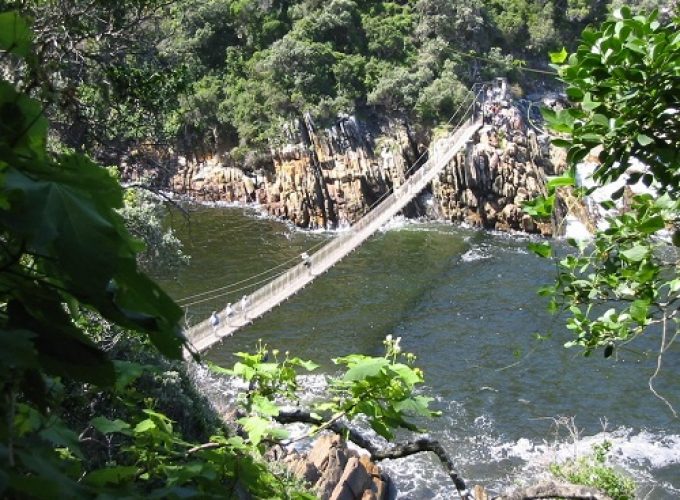
Day 3, Nature’s Valley, Tsitsikamma and Plettenberg Bay. Tsitsikamma is a Khoi word often translated as a place of abundant or sparkling water. Nature’s Valley lies inside the national park forest, and bushbuck and bushpigs are often seen near the village. Deep river gorges create waterfalls on the way to the sea.
Day 4, Knysna Heads and Mossel Bay. Free time at the waterfront, then the Post Office Tree and Diaz museum in Mossel Bay, where early sailors left letters for ships heading to Europe. Return via Swellendam to Cape Town by late afternoon.
The listing mentioned a vehicle with a registered guide, entrance fees, three nights of bed-and-breakfast accommodation and three dinners.
Spring to autumn is generally mild, whale watching peaks in the cooler months, and booking activities such as canopy tours ahead helps in school holidays. See the FAQ for general booking notes.
Many visitors pair the scenery with activities. Possibilities along the route include forest canopy tours in Tsitsikamma, a bungee jump from a famous bridge near Nature’s Valley, a coastal walk, a sea kayak, boat trips on the Knysna lagoon and a visit to a wildlife sanctuary. Book ahead for popular slots, and check weather and sea conditions the same morning.
Oysters and fresh fish are local specialities around Knysna. In the Little Karoo, ostrich steak is common, and the R62 is lined with farm stalls selling dried fruit, biltong and local wine. Vegetarians generally find plenty of choice in the larger towns.